Almost every traveler browsing Rajasthan Tour Packages eventually hits the same line item: “desert safari, Jaisalmer.” It sounds like a single, self-explanatory experience, and that’s exactly where the confusion starts, because “desert safari” in Jaisalmer is really an umbrella term covering three genuinely different experiences, a camel ride, a jeep-based dune bashing session, and an overnight camp stay, that get bundled together so often that first-time visitors assume they’re all the same thing with different price tags. They’re not. Each one delivers a different kind of experience, suits a different kind of traveler, and understanding the difference before you book will save you from either overpaying for something you didn’t want or missing the one experience that would have actually defined your trip.
The Camel Ride: Slow, Traditional, and Easy to Get Wrong\
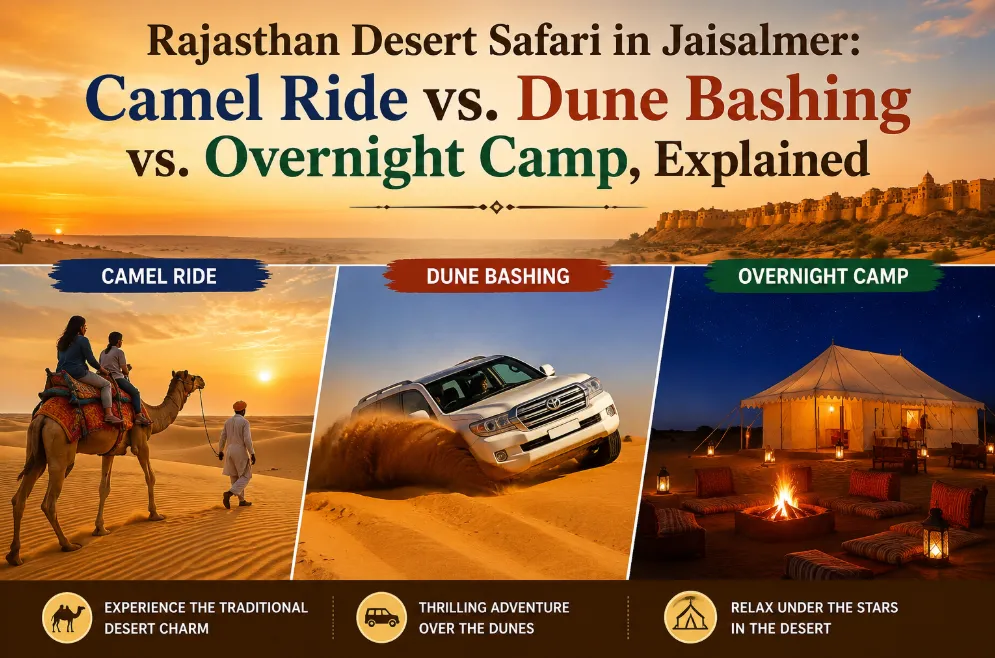
The camel ride is the oldest and most iconic version of a Jaisalmer desert safari, and it’s built around a simple premise: you sit atop a camel led by a local handler and cross a stretch of dunes at a walking pace, usually timed to end at sunset. Done well, it’s genuinely memorable; the light turns gold, the dunes ripple in long shadows, and the slow pace gives you time to actually notice the landscape rather than blast past it. Prices for a camel ride are relatively modest, typically ranging from around five hundred rupees for a short loop to two thousand rupees per person for a longer sunset ride, which makes it one of the more accessible parts of any Jaisalmer itinerary.
Where it goes wrong is almost always about location and expectation. At Sam Sand Dunes, the most famous and most visited site near Jaisalmer, peak-season evenings can feel closer to a carnival than a desert crossing, with rows of parked camels, competing handlers, quad bikes buzzing past, and a crowd density that undercuts the sense of remoteness most people are hoping for. If solitude and a genuine sense of desert isolation matter to you more than convenience, the quieter dunes at Khuri, a bit further from the city, deliver a noticeably calmer version of the same experience, with smaller crowds and a more authentic village feel around the camp.
Dune Bashing: The Adrenaline Option
Dune bashing swaps the camel for a 4×4 jeep and the slow crossing for a fast, bumpy, deliberately thrilling ride over the dune crests, with drivers who know exactly which slopes create the steepest drop and the best stomach-lurching moment. It’s the closest thing Jaisalmer’s desert offers to an amusement park ride, and it appeals to a completely different instinct than the camel safari does; this is about speed and adrenaline, not quiet contemplation of the landscape.
It’s also the most time-efficient of the three options, typically wrapped up in well under an hour, which makes it a strong fit for families with kids who won’t sit still for a slow camel crossing, or for travelers working with a tight schedule who still want a genuine desert experience without dedicating a half-day to it. The tradeoff is exactly what you’d expect: you’ll see less of the desert in a more compressed, less immersive way, and if what draws you to Jaisalmer is the romance of the landscape rather than the thrill of the ride, dune bashing alone will likely feel like it’s missing something.
The Overnight Camp: Where the Real Value Sits
The overnight camp is where a Jaisalmer desert safari stops being a single activity and becomes something closer to a full evening’s experience. A typical package combines a camel or jeep transfer out to the dunes, a folk music and dance performance around a bonfire as the sun sets, a traditional Rajasthani dinner, and then a night spent in a tent under a sky with remarkably little light pollution, before an early morning transfer back into the city. Budget and mid-range camp packages generally run somewhere between twenty-five hundred and forty-five hundred rupees per person, while the higher-end luxury glamping tents, complete with attached bathrooms and considerably more comfortable bedding, start closer to six thousand rupees and climb well beyond that depending on the operator.
This is genuinely the option that rewards spending the extra time and money, because it’s the only one of the three that captures the full arc of a desert evening rather than a single slice of it , the performance, the meal, the star-filled sky, and the strange quiet of a desert camp at 2 a.m. are all part of the same experience, and none of them show up in a quick sunset camel ride or a forty-minute jeep session. It’s also worth noting that the same Sam-versus-Khuri tradeoff applies here: Sam has a far larger concentration of camps and a livelier, more social atmosphere, while Khuri’s camps tend to be smaller, quieter, and better suited to travelers who want the desert experience to feel remote rather than curated for a crowd.
Matching the Choice to Your Trip
If you’re working with limited time or traveling with young children, dune bashing paired with a short camel ride at sunset covers the core experience in a single evening without requiring an overnight stay away from your hotel. If you have at least one extra day built into your Jaisalmer stop, the overnight camp is worth prioritizing over the other two, since it effectively includes elements of both while adding the parts- the music, the dinner, the stars, that make the desert feel like a destination rather than a photo opportunity. Many operators structuring Rajasthan Tour Packages have started defaulting to the overnight camp for exactly this reason, since it consistently ranks as the highlight of the trip in traveler feedback, more often than the forts that get top billing on the itinerary.
Budget-conscious travelers can also mix and match rather than treating these as three separate purchases. A short, inexpensive camel ride at sunset followed by a return to a hotel in the city keeps costs down while still delivering the classic photograph and experience, and it’s a perfectly reasonable choice if an overnight camp doesn’t fit your schedule or budget. What matters most is going in with a clear sense of which experience you’re actually booking, since a rushed camel ride marketed as a “desert safari” and a full overnight camp marketed with the same phrase are, in practical terms, entirely different evenings.
What Nobody Mentions Until You’re Already There
One detail that catches a lot of first-time visitors off guard is just how dramatically the temperature swings once the sun goes down. Daytime desert heat, even in the cooler months, can feel intense enough that travelers assume the evening will bring only mild relief; instead, desert nights drop sharply, and anyone staying overnight without a proper jacket or layered clothing tends to spend a miserable few hours regretting it. Camps generally provide blankets, but a lot of experienced travelers pack a warm layer regardless, especially between November and February when nighttime temperatures can fall close to single digits.
The other thing worth knowing in advance is that the folk music and dance performance included in most overnight camp packages isn’t filler between dinner and bedtime; it’s often the most memorable part of the evening, featuring local Manganiyar or Langa musicians whose families have performed this same repertoire for generations. Treating it as background noise while checking phones is a common mistake; the performers are usually happy to explain the instruments or songs if you show genuine interest, and it’s one of the few moments on a typical Rajasthan trip where the cultural experience isn’t mediated by a monument or a guide reciting dates.
Finally, sand and electronics don’t mix well, and dune bashing in particular kicks up enough fine sand to work its way into camera bags and phone ports if you’re not careful. A simple dry bag or sealed pouch for anything electronic is a small precaution that saves a surprising number of travelers from ending their desert evening with a jammed camera or a phone that won’t charge.
A Few Practical Notes Before You Book
The best window for a Jaisalmer desert safari runs from October through March, when daytime temperatures are manageable and desert nights are genuinely pleasant rather than punishing; visiting in peak summer turns even a short camel ride into an endurance test. It’s also worth booking through a known operator or as part of a structured itinerary rather than negotiating directly with touts at the dunes, since pricing at the more crowded sites can vary wildly for essentially the same experience depending on how the negotiation goes. When comparing Rajasthan Tour Packages that include a Jaisalmer desert component, it’s worth asking specifically which of the three experiences is included, whether it’s at Sam or Khuri, and whether an overnight stay is part of the package or an optional add-on, since that single detail will shape your evening in the desert far more than any other line item in the itinerary.
