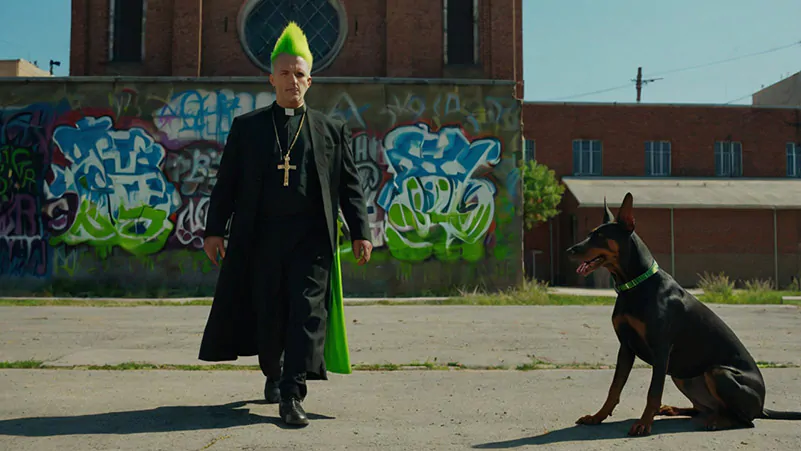
Punk names work well for dogs — provided the name meets a few basic phonetic and behavioral criteria. The challenge is not finding a punk-inspired name that sounds cool to the owner; it is finding one that the dog can actually recognize and respond to, and that will remain appropriate across the dog’s entire lifespan.
What Counts as a Punk Name?
A dog punk name draws its identity from the punk subculture that emerged in the mid-1970s in New York (around 1974) and the United Kingdom (around 1976). The names in this category fall into three distinct groups: names borrowed directly from punk musicians and bands, names that carry punk-coded vocabulary or concepts, and names that reflect the aesthetic and attitude of the subculture without a direct musical reference.
The word “punk” itself carries contested etymology — some linguistic sources trace it to prison slang, while others tie it to earlier uses meaning something weak or worthless that was later reclaimed as a symbol of raw energy. That reclamation is central to how the subculture names itself and its participants. A dog named Sid, Ramone, or Anarchy inherits that layer of cultural context.
Proto-punk influences from bands such as The Stooges, The Velvet Underground, and MC5 preceded the movement’s peak by nearly a decade. Names pulled from those precursors — Iggy (after Iggy Pop of The Stooges) or Lou (after Lou Reed of The Velvet Underground) — carry a deeper, more obscure cultural signal, which appeals to owners who want specificity over surface-level recognition.
Do Punk Names Fit How Dogs Process Language?
Dogs do not understand names as semantic labels in the way humans do — they recognize them as sound patterns associated with a specific behavioral outcome. This means a punk name is “suitable” for a dog not because of its cultural weight, but because of its phonetic structure.
Research consistently shows that dogs respond most reliably to names with one or two syllables, a hard consonant, and a clear vowel. Names like Sid, Clash, Rox, Mick (after Mick Jones of The Clash), or Dee (from Dee Dee Ramone) satisfy all three conditions. Longer names — Anarchy, Siouxsie, Biafra — can be used as registered names, with a shortened call name used in daily training.
A 2023 report by PetMD confirmed that dogs can learn and recognize their name as a meaningful word, and that most dogs understand 150 or more words, with positive reinforcement being the most effective method for establishing name recognition. This means that even an unusual punk name like Danzig or Jello becomes functional once trained through consistent reward association. The name’s cultural strangeness does not impede learning.
One-Syllable Punk Names That Work Phonetically
Single-syllable punk names combine immediate recall performance with cultural density. Examples sourced from punk history include:
- Sid (after Sid Vicious, bassist of the Sex Pistols)
- Clash (after the London band formed in 1976)
- Ratt, Spit, Snot, Slag — terms used within punk vocabulary
- Gig, Pit (as in mosh pit — high-energy context name)
- Mick (Mick Jones, The Clash)
- Joe (Joe Strummer, The Clash)
- Paul (Paul Simonon or Paul Cook)
These work at a training level because the dog hears a clear, non-ambiguous sound unit that does not blend into common household speech.
Punk Names Drawn from Bands and Musicians
The densest source of punk dog names comes from the bands and artists who defined the genre between 1974 and 1985, and from the hardcore and post-punk movements that followed.
Names from the Ramones, Sex Pistols, and The Clash
The Ramones provided some of the most adaptable punk names for dogs precisely because the band members all adopted the shared surname “Ramone.” Joey, Johnny, Dee Dee, and Tommy all function as standard dog names with an embedded punk identity. The name Ramone itself — a word of Spanish origin meaning “wise protector” — has a strong phonetic profile and a dual layer of cultural meaning.
From the Sex Pistols, the most used dog name is Sid (Sid Vicious, born John Ritchie), which has become nearly generic in dog-naming circles despite retaining its punk association. Johnny (after Johnny Rotten, born John Lydon) is similarly common. Steve (after guitarist Steve Jones) is less loaded but still traceable to the band’s original lineup.
The Clash generates names with a different energy — Joe (Strummer), Mick (Jones), Paul (Simonon), and Topper (Headon) — that carry a more politically charged connotation than the nihilism of the Sex Pistols. Joe Strummer was known for his commitment to social justice within punk ideology, making this a name with depth beyond shock value.
Names from Hardcore, Riot Grrrl, and Post-Punk
The hardcore punk movement of the early 1980s — associated with bands like Dead Kennedys, Black Flag, Minor Threat, and Bad Brains — produced names that are more aggressive in sound: Jello (after Jello Biafra of Dead Kennedys), Rollins (after Henry Rollins of Black Flag), and Ian (after Ian MacKaye of Minor Threat and later Fugazi).
The riot grrrl movement of the early 1990s, centered around bands like Bikini Kill and Sleater-Kinney, introduced female punk names with strong phonetic profiles: Kathleen (Hanna, vocalist of Bikini Kill), Corin (Tucker, Sleater-Kinney), and Carrie (Brownstein, Sleater-Kinney). These fit naturally as female dog names without requiring the owner to explain their origin.
Post-punk added names from Siouxsie and the Banshees — Siouxsie (after Siouxsie Sioux) — as well as from The Cramps (Lux, after Lux Interior), and X-Ray Spex (Poly, after Poly Styrene). Siouxsie Sioux was one of the women credited with contributing to the original punk sound and aesthetic alongside Patti Smith, the so-called “godmother of punk”.
Punk Vocabulary and Concept Names for Dogs
Beyond musician names, punk culture generated a distinct vocabulary of terms that translate cleanly into dog names. These names carry the ideological freight of the subculture without requiring knowledge of a specific band.
Anarchy, Riot, Rebel, Rogue, and Chaos are the most recognizable concept names in this category. They work best for large-breed dogs whose physical presence matches the name’s energy — a Rottweiler or Doberman named Riot reads as coherent; a Chihuahua named Riot reads as ironic, which is itself a punk move.
Mohawk — the hairstyle that became the visual signature of punk fashion alongside leather jackets, safety pins, and torn clothing — has crossed into dog naming, particularly for dogs with naturally upright fur ridges (Rhodesian Ridgebacks, Xoloitzcuintlis). The name Spike, which references both the hairstyle and the physical aesthetic of studded accessories, is among the most popular punk-adjacent dog names globally.
DIY (Do It Yourself) was a core punk ethos, originating from the movement’s rejection of major record labels and commercial music production. Names like Craft, Zine (from fanzine culture), or Demo (as in demo tape) reference this production philosophy rather than the music itself — a more obscure category suited to owners with a deeper understanding of punk as a cultural movement rather than just a genre.
Male vs. Female Punk Dog Names
The punk subculture was, in its origins, dominated by white working-class male figures, which means the available pool of male punk names is larger and more varied. However, female punk figures — Patti Smith, Siouxsie Sioux, Poly Styrene, Exene Cervenka of X, and Kathleen Hanna — generated names that are distinctive precisely because they are less common in mainstream naming pools.
Male Punk Names with Source Context
| Name | Source | Phonetic Profile |
| Sid | Sid Vicious, Sex Pistols | 1 syllable, hard consonant |
| Joey | Joey Ramone, The Ramones | 2 syllables, soft vowel |
| Danzig | Glenn Danzig, The Misfits | 2 syllables, hard ending |
| Jello | Jello Biafra, Dead Kennedys | 2 syllables, open vowel |
| Rollins | Henry Rollins, Black Flag | 2 syllables, clean consonant |
| Mick | Mick Jones, The Clash | 1 syllable, hard consonant |
| Thurston | Thurston Moore, Sonic Youth | 2 syllables, distinctive |
| Lux | Lux Interior, The Cramps | 1 syllable, hard ending |
| Ian | Ian MacKaye, Minor Threat | 2 syllables, soft |
Female Punk Names with Source Context
| Name | Source | Phonetic Profile |
| Patti | Patti Smith | 2 syllables, soft ending |
| Poly | Poly Styrene, X-Ray Spex | 2 syllables, open vowel |
| Exene | Exene Cervenka, X | 3 syllables, unusual |
| Siouxsie | Siouxsie Sioux | 2 syllables, unique spelling |
| Bettie | Bettie Page (rockabilly/punk crossover) | 2 syllables, familiar |
| Corin | Corin Tucker, Sleater-Kinney | 2 syllables, neutral |
| Kimya | Kimya Dawson, Moldy Peaches | 2 syllables, distinctive |
Punk Names and Breed Compatibility
The cultural weight of a punk name interacts with a dog’s physical type in ways that are not merely aesthetic. A dog named after a specific musician is often expected to carry some behavioral resemblance — Dee Dee Ramone was famously erratic and lovable; Patti Smith is associated with poetic seriousness; Glenn Danzig with brooding physicality.
High-energy breeds — Border Collies, Jack Russell Terriers, Australian Shepherds — pair naturally with names that carry kinetic punk energy: Riot, Clash, Mosh, or Spike. Calm, dignified breeds — Basset Hounds, Great Danes, Newfoundlands — can carry ironic punk names effectively. A Great Dane named Anarchy or a Basset Hound named Sid Vicious performs the punk gesture of subverting expectations, which is arguably more authentic to the subculture’s ethos than a straightforward aggressive pairing.
Working dogs in formal training environments — police dogs, service dogs, guide dogs — typically require names that handlers from multiple agencies can pronounce without variation. Punk names with ambiguous pronunciation (Siouxsie, Exene, Biafra) create operational friction and are unsuitable in those contexts. Standard punk names like Sid, Mick, or Spike have no such limitation.
Longevity of Punk Names Across a Dog’s Lifespan
A dog lives 10 to 15 years on average, depending on breed and size. A name selected at the puppy stage remains in daily use for that entire period. Punk names with strong cultural associations to specific historical figures or bands carry the risk of losing cultural legibility as the owner ages and the reference becomes less immediately recognizable to veterinarians, dog sitters, and kennel staff.
Names like Sid, Joey, Patti, or Mick function as normal human names that happen to carry punk significance — they retain social utility regardless of the listener’s cultural knowledge. Names like Jello, Danzig, or Exene are more opaque and require explanation in professional settings. Neither category is wrong, but the practical demand on the owner differs substantially.
Punk as a subculture has demonstrated unusual longevity for a youth movement — the original UK punk explosion of 1976 and 1977 generated bands that are still critically referenced and commercially active nearly fifty years later. Names drawn from that period carry a cultural durability that trend-based pet names (drawn from television characters or contemporary pop music) typically do not.
Punk Names for Dogs — Practical Selection Criteria
Three criteria determine whether a punk name is genuinely suitable for a specific dog, as opposed to suitable in concept:
- Phonetic clarity — the name produces a distinct, consistent sound pattern the dog can isolate from background speech; one or two syllables, a hard consonant or a prominent vowel, no phonetic similarity to common command words (no, sit, stay, come).
- Stability of association — the name should not create confusion in multi-dog households or produce sounds identical to the names of other pets in the same space.
- Cultural accountability — the owner should know what the name means and where it comes from, since veterinary records, registration papers, and public interactions will require that name to stand on its own.
A punk name chosen without knowledge of its origin is an aesthetic accessory. A punk name chosen with full understanding of Dee Dee Ramone’s biography, Patti Smith’s literary output, or Joe Strummer’s political convictions is a genuinely expressive naming decision — and that distinction tracks directly back to punk’s central argument against surface-level consumption.
