Tires do a lot more than most drivers think about. They carry the weight of the vehicle, grip the road, handle braking, support steering, and help keep the ride smooth. But because tires wear down slowly, it can be hard to know when something is normal and when it is time to take action.
Sometimes your car does not need new tires yet. It may only need a tire rotation. Other times, rotating the tires will not solve the problem because the tread is already too worn, the rubber is damaged, or the tire has aged out.
Knowing the difference can help you save money and stay safer on the road.
What Does a Tire Rotation Do?
A tire rotation means moving the tires from one position on the vehicle to another. For example, the front tires may move to the back, and the back tires may move to the front.
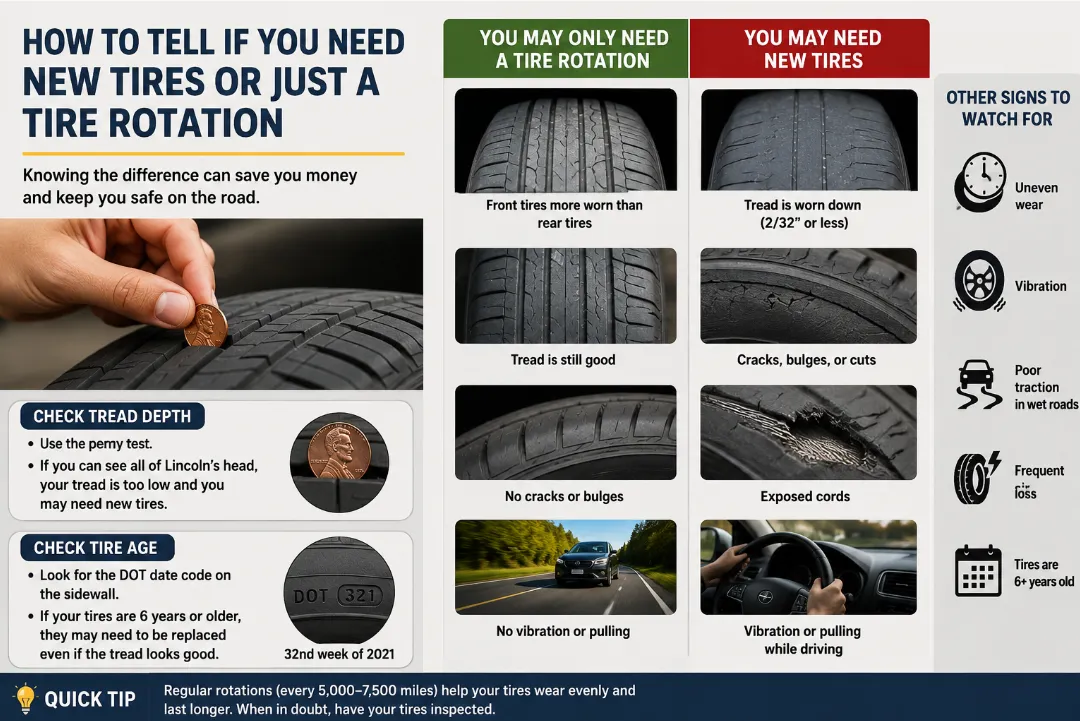
This matters because tires do not always wear evenly. Front tires often wear faster because they handle steering and more braking force. On front-wheel-drive vehicles, the front tires also do most of the pulling. Over time, this creates uneven wear between the front and rear tires.
A tire rotation helps spread wear more evenly across all four tires. It does not make damaged tires new again, but it can help extend the life of tires that are still in good condition.
Signs You May Only Need a Tire Rotation
One common sign you need a tire rotation is uneven tread wear. If the front tires look more worn than the rear tires, but all tires still have enough tread, rotation may help.
Another sign is mild vibration while driving. Sometimes, uneven tire wear can cause a light shake, especially at higher speeds. Rotation may help, though balancing may also be needed.
You may also notice the vehicle feels slightly different when turning or braking. If the tires are still healthy, rotating them can help even things out again.
A tire rotation may be enough if:
- The tread is still deep enough
- There are no cracks or bulges
- The tires are not too old
- The wear is uneven but not severe
- The vehicle does not pull hard to one side
- There is no exposed cord or serious damage
In simple terms, rotation is best when the tire is still usable but wearing unevenly.
Signs You Need New Tires
New tires may be needed when the tread is too low. Tread depth affects traction, especially on wet roads. If the tread is worn down, the tire has a harder time pushing water away. This can increase the risk of sliding or hydroplaning.
A quick check is the penny test. Place a penny into the tread with Lincoln’s head facing down. If you can see all of Lincoln’s head, the tread is likely too low and the tire should be replaced.
You should also look for the tread wear bars. These are small raised rubber bars inside the grooves of the tire. If the tread is level with those bars, the tire is worn out.
New tires may also be needed if you see:
- Cracks in the sidewall
- Bulges or bubbles
- Deep cuts
- Exposed wires or cords
- Repeated air loss
- Flat spots
- Severe uneven wear
- Tread separating from the tire
A tire rotation cannot fix these problems. If the tire structure is damaged, replacement is the safer choice.
Pay Attention to Tire Age
Even if the tread looks decent, tires can get too old. Rubber breaks down over time because of heat, sunlight, road conditions, and age. This is especially true in warm climates where pavement heat can be harsh.
Most tires have a date code on the sidewall. It is usually part of the DOT number. The last four digits show the week and year the tire was made. For example, “3221” means the tire was made in the 32nd week of 2021.
If your tires are around six years old or more, they should be inspected carefully. Some tires may last longer, but age matters. A tire can look okay and still be weaker than it should be.
What Uneven Wear Can Tell You
Uneven tire wear is a clue. It can tell you whether you need rotation, alignment, balancing, or new tires.
If the center of the tire is more worn than the edges, the tire may be overinflated. If both outer edges are worn, it may be underinflated. If one edge is worn more than the other, the vehicle may need an alignment.
Cupping or patchy wear may point to suspension issues, worn shocks, or tire imbalance.
This is important because replacing tires without fixing the cause can lead to the same problem again. If your tires are wearing unevenly, do not only ask, “Do I need new tires?” Also ask, “Why did they wear this way?”
When Rotation Is Not Enough
A tire rotation will not solve every tire problem. If your tires are already bald, cracked, or damaged, rotating them only moves the problem to another position.
Rotation also will not fix alignment problems. If your car pulls to one side, your steering wheel is off-center, or one tire is wearing much faster than the others, you may need an alignment check.
The same goes for vibration. If the shaking continues after rotation, the tires may need balancing, or there may be another issue with the wheels or suspension.
How Often Should You Rotate Tires?
Many drivers rotate tires every 5,000 to 7,500 miles, but the right schedule depends on your vehicle, tire type, and driving habits. A good habit is to rotate your tires around the same time as your oil change, if that matches your maintenance schedule.
Regular rotation helps your tires wear evenly and makes it easier to spot problems early.
Final Thoughts
The main difference between needing new tires and needing a tire rotation comes down to condition. If the tires still have good tread, no major damage, and are wearing unevenly, a rotation may be enough. If the tread is too low, the rubber is cracked, the tire is damaged, or the tire is too old, replacement is the safer option.
Do not ignore tire problems. Tires affect braking, steering, fuel use, and overall safety. A simple check every few weeks can help you catch issues before they become expensive or dangerous.
When in doubt, have the tires inspected. Sometimes the fix is simple. Sometimes new tires are the smarter choice. Either way, knowing the signs helps you make a safer decision.
This post was written by a professional at Tires2Go Florida. Tires2Go Florida is a trusted automotive service center located in Pinellas Park, Florida, serving drivers across St. Petersburg, Tampa, Clearwater, and Largo. Our certified mechanics handle tire shop Tampa and wheel replacement, brake service, suspension repairs, oil changes, wheel alignments, tire balancing, and road force balancing. We also specialize in ADAS calibration, suspension modifications, lift kits, and lowering kits using quality parts and modern diagnostic equipment. From routine maintenance to advanced automotive services, Tires2Go Florida provides dependable solutions and tires for sale for vehicles throughout the Tampa Bay area.
